#NationalFormerPOWDay
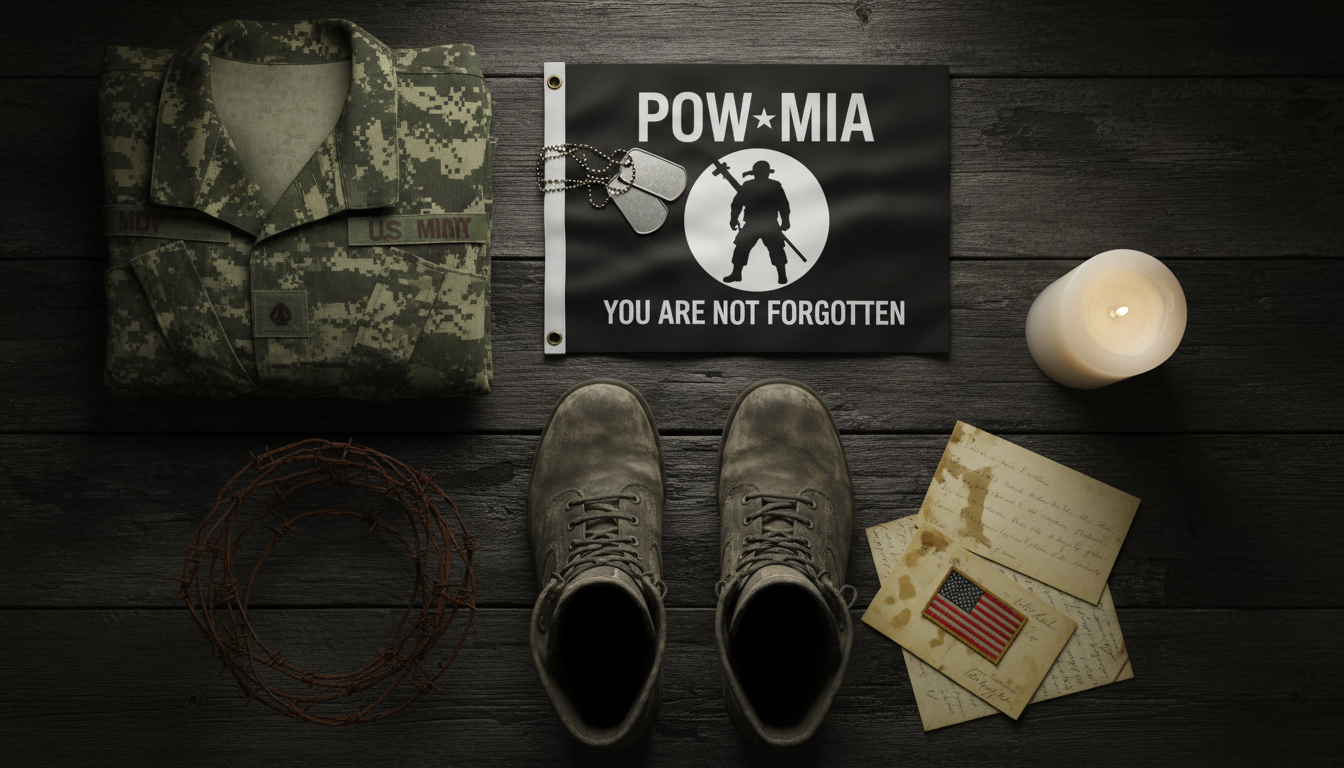
Fly the POW/MIA flag today in remembrance of those who have been or are Prisoners of War.
What Does #NationalFormerPOWDay Mean?
National Former Prisoner of War Recognition Day on April 9th honors all Americans who endured captivity during military service. The date was chosen because it marks the fall of Bataan in 1942, when tens of thousands of American and Filipino soldiers became prisoners of war. It's a solemn day of remembrance for their sacrifice and resilience.
How to Use #NationalFormerPOWDay
Share a message of gratitude and respect for former POWs. Post the POW/MIA flag or share a historical fact about POW experiences. Keep the tone respectful and somber - this is a day of honor, not promotion.
The History Behind National Former POW Recognition Day
National Former Prisoner of War Recognition Day falls on April 9th, and the date was not chosen randomly. On April 9, 1942, roughly 75,000 American and Filipino soldiers surrendered to Japanese forces on the Bataan Peninsula in the Philippines. It was the largest surrender of American-led forces in history, and what followed was one of the most brutal episodes of World War II - the Bataan Death March.
The march covered approximately 65 miles in blistering tropical heat. Prisoners were denied food and water, beaten, bayoneted, and shot if they fell behind. Estimates vary, but between 5,000 and 18,000 Filipino soldiers and 500 to 650 American soldiers died during the march itself. Those who survived faced years of captivity in prison camps where conditions were barely better.
Congress officially designated April 9th as National Former Prisoner of War Recognition Day in 1987. It is not just about World War II, though. The day honors every American who has endured captivity during military service - from the Revolutionary War through the conflicts in Iraq and Afghanistan.
POW Experiences Across American Wars
The prisoner of war experience has been a constant in American military history, but the conditions and circumstances have varied enormously. During the Civil War, prison camps on both sides became synonymous with suffering. Andersonville, the Confederate prison camp in Georgia, held roughly 45,000 Union prisoners over its 14 months of operation. Nearly 13,000 died from starvation, disease, and exposure. The camp commandant, Captain Henry Wirz, was tried and executed after the war - one of only two people executed for war crimes during the entire conflict.
World War I saw relatively humane treatment of POWs by comparison, at least on the Western Front. The 1907 Hague Convention had established basic protections for prisoners, and both sides generally followed them. Officers received better quarters and were sometimes allowed to receive packages from home. Enlisted men worked in labor details but were typically fed and housed.
The Pacific Theater of World War II was a different situation entirely. Japan had not ratified the 1929 Geneva Convention on POWs, and Japanese military culture viewed surrender as deeply dishonorable. American prisoners in the Pacific endured forced labor, systematic starvation, torture, and medical experiments. The construction of the Burma-Thailand railway - the "Death Railway" made famous by the film The Bridge on the River Kwai - killed an estimated 12,000 Allied POWs out of roughly 60,000 forced to work on it.
Korea brought new tactics. Chinese and North Korean captors used psychological warfare extensively. "Brainwashing" entered the American vocabulary during this period. Captors isolated prisoners, forced them to write confessions, and used a combination of deprivation and ideological pressure to break their will. Twenty-one American POWs refused repatriation at the end of the war, choosing to stay in China - a propaganda victory that shook the American public.
Vietnam produced the most well-known American POW stories. The "Hanoi Hilton" - Hoa Lo Prison - held hundreds of American pilots and aircrew, some for over seven years. Senator John McCain spent more than five years there after his plane was shot down in 1967. He was tortured repeatedly and sustained injuries that affected him for the rest of his life. Admiral James Stockdale, held for over seven years, received the Medal of Honor for his leadership among prisoners and his resistance to captors despite brutal torture.
The POW/MIA Flag and Its Meaning
The black and white POW/MIA flag is one of the most recognized symbols in American military culture. It features a silhouette of a bowed head, a guard tower, and a strand of barbed wire, with the words "You Are Not Forgotten" along the bottom. The National League of Families of American Prisoners and Missing in Southeast Asia created the flag in 1971 during the Vietnam War, when the fate of hundreds of missing servicemembers was unknown.
In 2019, Congress passed a law requiring the flag to be displayed at all federal buildings, national cemeteries, and post offices on six specific days throughout the year, including Armed Forces Day, Memorial Day, and National POW/MIA Recognition Day in September. The April 9th observance and the September recognition day serve different purposes - April focuses specifically on former prisoners, while September honors both POWs and those still missing in action.
There are still over 81,000 Americans missing from conflicts dating back to World War II. The Defense POW/MIA Accounting Agency (DPAA) actively works to recover and identify remains, using modern DNA technology, underwater archaeology, and historical research. They identify an average of around 100 individuals per year - decades after their loss.
What Captivity Does to People
The long-term effects of being a prisoner of war extend far beyond the physical. Research from the Veterans Administration has shown that former POWs experience post-traumatic stress disorder at significantly higher rates than other combat veterans. Many struggled with survivor's guilt - wondering why they made it home when others did not.
But the stories also include remarkable resilience. POWs in Vietnam developed elaborate communication systems using wall taps based on a five-by-five grid of the alphabet. They held secret church services, maintained military command structures within the prison, and supported each other through years of isolation. Some memorized the names of every prisoner they encountered so the information could be passed along if anyone was released.
The Code of Conduct for members of the United States Armed Forces, established by President Eisenhower in 1955, was partly a response to POW experiences in Korea. It provides guidelines for how servicemembers should behave if captured - resist, provide only name, rank, service number, and date of birth, and never give up hope. The code acknowledges that no one can be expected to hold out indefinitely under torture, but it establishes a standard of resistance that has guided American prisoners through every conflict since.
How to Honor the Day on Social Media
This is a day that calls for respect rather than promotion. Share the POW/MIA flag or a brief historical fact about prisoner of war experiences. If you know a veteran who was a POW, ask if they would be comfortable with you sharing their story. Many former prisoners want their experiences remembered - not for sympathy, but so future generations understand what was sacrificed.
Keep the tone serious and factual. This is not a day for "happy holiday" messaging or brand promotion. A simple message of gratitude and remembrance is appropriate. Local VFW posts and American Legion chapters often hold ceremonies on April 9th, and sharing information about those events helps build community awareness.
Related Hashtags
For other days of remembrance and national observance, check out these hashtag pages: #EarthDay, #NursesDay, #NationalTelephoneDay, #AllIsOursDay, and #NationalSiblingsDay.
Quick Info
-
Hashtag#NationalFormerPOWDay
-
When to PostApril 9th
-
Full GuideAvailable below
Related Hashtags
Find More Hashtags
Search across 830+ curated hashtags