#EmpanadaDay
Don't forget to grab an empanada today, it's this snack's official holiday!
What Does #EmpanadaDay Mean?
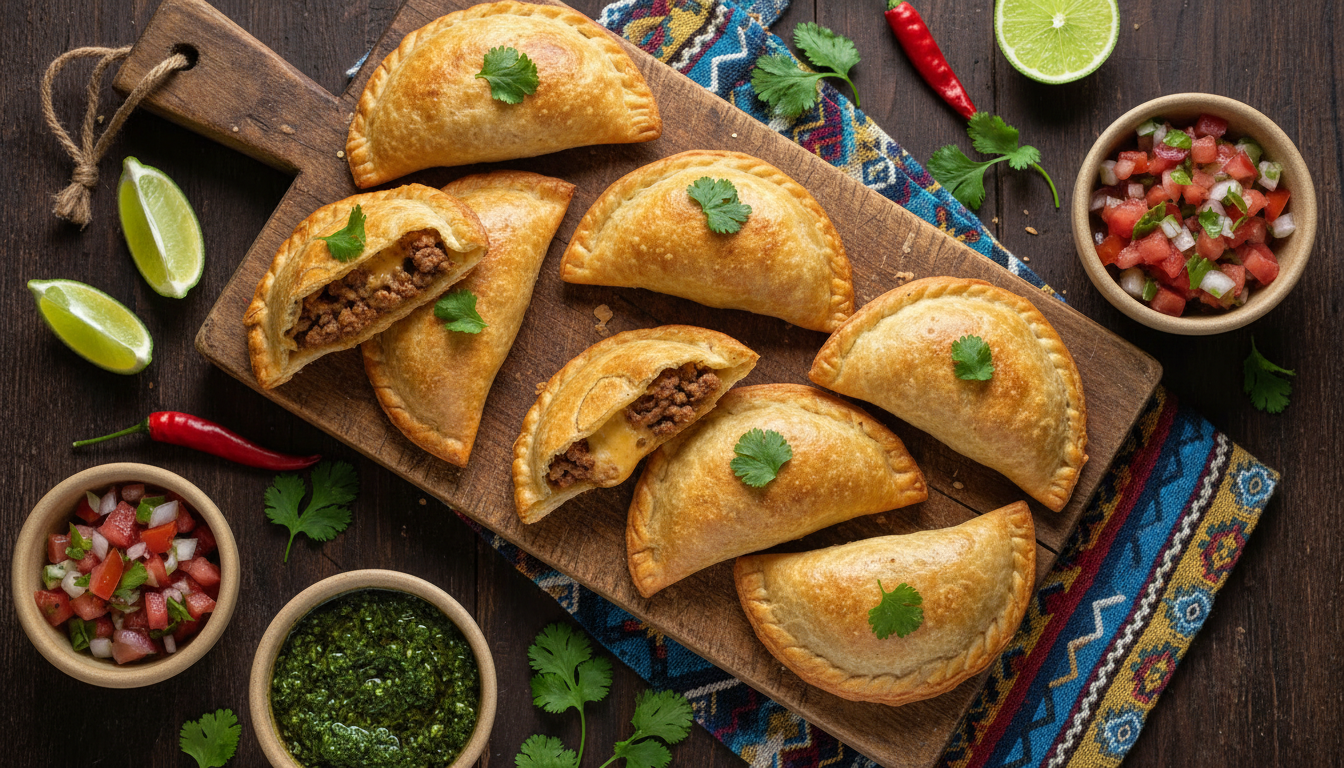
National Empanada Day on April 8th celebrates the beloved stuffed pastry that has roots in Spanish, Latin American, and Filipino cuisines. Empanadas can be baked or fried and filled with everything from seasoned beef and cheese to sweet fillings like guava. They're handheld, portable, and universally delicious.
How to Use #EmpanadaDay
Post a photo of empanadas you made or ordered. Share your favorite filling combo or tag a restaurant that makes great ones. Food content always performs well, so get that close-up shot.
What Is National Empanada Day?
National Empanada Day falls on April 8th, and it celebrates one of the most versatile handheld foods ever invented. The empanada - from the Spanish empanar, meaning "to wrap in bread" - is a stuffed pastry that shows up across dozens of cultures, each with its own twist. Crispy or baked, savory or sweet, the empanada is street food, party food, and comfort food all at once.
The beauty of the empanada is its simplicity. Take some dough, fill it with whatever you have, fold it shut, and cook it. That formula has made it a staple from Buenos Aires to Manila, and the variations are staggering.
A Pastry With Deep Roots
Empanadas trace their origins to the Iberian Peninsula. The earliest known recipe appears in a 1520 Catalan cookbook, but the concept is much older. Moorish influence on Spanish cuisine during the medieval period likely brought stuffed pastries to the region - similar to the samosa of South Asia and the börek of the Ottoman Empire, all descendants of ancient Middle Eastern filled doughs.
When Spanish and Portuguese colonizers arrived in the Americas, they brought the empanada with them. But the genius of this food is how completely each culture made it their own. Argentine empanadas from Salta use potatoes and a mild chili pepper. In Tucumán, they are smaller and packed with spiced beef, hard-boiled eggs, and olives. Colombian empanadas use corn-based dough instead of wheat, giving them a distinctive yellow crunch. Chilean empanadas de pino are massive half-moons stuffed with ground beef, onions, raisins, and a slice of hard-boiled egg.
In the Philippines, the empanada took on a completely different character. Ilocos-style empanadas use rice flour dough dyed orange with annatto seeds, filled with green papaya, mung beans, egg, and longganisa sausage. They are deep-fried to an almost architectural crispness.
The Science of a Good Crust
What separates an incredible empanada from a forgettable one usually comes down to the dough. Professional empanada makers obsess over the ratio of fat to flour. In Argentina, many use beef fat (rendered grasa) instead of butter, which produces a flakier, more savory crust that practically shatters when you bite into it.
The repulgue - that crimped edge running along the sealed side - is more than decorative. It locks moisture inside so the filling steams while the outside crisps. Skilled empanada makers develop signature crimping patterns. In some regions of Argentina, you can tell the filling just by looking at the fold pattern, even before taking a bite. A braided edge might signal beef, while a simpler fork-press could mean ham and cheese.
Frying versus baking creates two fundamentally different experiences. Fried empanadas develop a bubbled, golden exterior with a crunch that holds up for minutes even after cooling. Baked versions tend toward a softer, bread-like shell with an egg-wash shine. Neither is better - they serve different purposes. Street vendors almost always fry. Home cooks who are feeding a crowd tend to bake.
Empanadas in the American Food Scene
The empanada explosion in the United States really picked up speed in the 2010s. Food trucks in cities like Miami, New York, and Los Angeles made them accessible beyond traditional Latin neighborhoods. Chains like Empanada Mama in New York City and Buen Provecho in Houston proved that empanada-focused restaurants could thrive as standalone concepts.
What made empanadas click with American food culture is their grab-and-go format. They are essentially the perfect handheld meal - self-contained, no utensils needed, endlessly customizable. That adaptability led to fusion fillings you would never find in South America: buffalo chicken, mac and cheese, Philly cheesesteak, even Nutella and banana for dessert. Purists might cringe, but it is exactly this flexibility that has kept the empanada relevant for five centuries.
The frozen empanada market has grown substantially too. Goya Foods, the largest Hispanic-owned food company in the US, sells millions of empanada discs (pre-rolled dough circles) annually. Their product effectively democratized empanada-making for home cooks who did not grow up learning to make dough from scratch.
How to Celebrate on Social Media
Food content dominates social media engagement, and empanadas are particularly photogenic. That golden crust, the moment of breaking one open to reveal the steaming filling inside - it is built for the close-up shot. Share your homemade empanadas or tag a local spot that makes great ones. If you are feeling ambitious, post a video of the folding and crimping process. Recipe content performs especially well when it shows the technique rather than just the finished product.
Ask your followers about their favorite fillings or regional styles. Debates about food traditions always generate comments. And if you have a family recipe that has been passed down, telling that story adds depth that a simple food photo cannot.
Related Hashtags
If you are celebrating food holidays, check out these related hashtag pages: #DeepDishPizzaDay, #ChineseAlmondCookieDay, #NationalTacoDay, #FoodFriday, and #JunkFoodDay.
Quick Info
-
Hashtag#EmpanadaDay
-
When to PostApril 8th
-
Full GuideAvailable below
Related Hashtags
Find More Hashtags
Search across 830+ curated hashtags