#FindARainbow
Celebrate Spring and get your camera ready, it's National Find a Rainbow Day!
What Does #FindARainbow Mean?
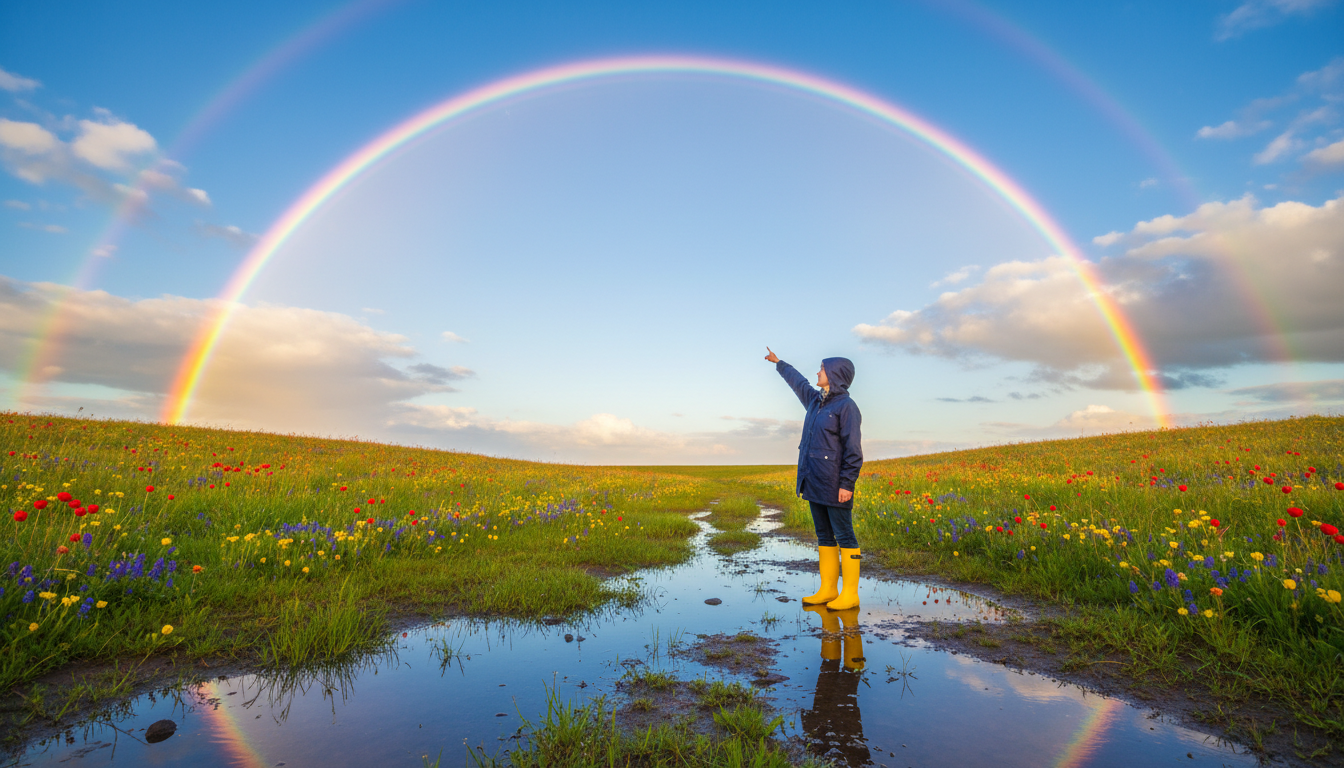
National Find a Rainbow Day on April 3rd celebrates those magical moments when light and rain combine to create something beautiful. Spring showers make April prime rainbow season in many parts of the world. The day encourages people to look up and appreciate natural beauty.
How to Use #FindARainbow
Share a rainbow photo you've captured, or create rainbow-themed content (art, food, outfits). If you can't find a real rainbow, make your own with a prism or water hose. Colorful product flat-lays also work well with this hashtag.
The Physics Behind the Most Photographed Weather Event on Earth
National Find a Rainbow Day on April 3rd falls right when spring showers start delivering the exact conditions your eyes need to see one: sunlight entering millions of water droplets simultaneously, each one acting as a tiny prism. When light hits a raindrop, it slows down, bends, bounces off the back of the drop, and exits at a different angle than it entered. Different wavelengths bend at slightly different degrees — red the least at about 42 degrees, violet the most at about 40 degrees — which is why the colors always appear in the same order. You are not looking at one rainbow. You are looking at millions of individual droplets, each sending one specific color to your eye based on its position relative to you.
This is why no two people ever see the exact same rainbow. Your rainbow is literally yours — constructed from a unique set of droplets at angles specific to where you’re standing. Move ten feet to the left and you’re seeing light from a completely different set of water droplets. The rainbow you photograph is different from the one the person next to you photographs, even though you’re both pointing cameras at the same sky.
The Rainbows Most People Never See
Double rainbows happen when light bounces twice inside each raindrop instead of once. The second reflection sends light out at a wider angle, creating a fainter arc above the primary rainbow with its colors reversed — red on the inside, violet on the outside. The dark band between the two arcs is called Alexander’s Band, named after Alexander of Aphrodisias who first described it around 200 AD. That dark space exists because no light from the raindrops reaches your eyes at those specific angles.
Then there are moonbows — rainbows created by moonlight instead of sunlight. They follow the same physics but appear ghostly white to the naked eye because the light is too dim to activate your color-sensing cone cells. Long-exposure photography reveals they’re actually full-color. You need a full or nearly full moon low in the sky, rain or mist in the opposite direction, and very dark surroundings. Cumberland Falls in Kentucky and Victoria Falls on the Zambia-Zimbabwe border are two of the most reliable spots on Earth to see one.
Fire rainbows — properly called circumhorizontal arcs — are not actually rainbows at all. They form when sunlight refracts through hexagonal ice crystals in high-altitude cirrus clouds, creating a brilliant band of color that runs parallel to the horizon. They require the sun to be higher than 58 degrees above the horizon, which means they’re impossible to see anywhere north of 55°N latitude. If you live in the United States, summer is your window.
And yes — from an airplane above 30,000 feet, you can see a complete circular rainbow. The ground normally blocks the lower half of the arc, but when you’re high enough with the sun behind you and rain below, the full 360-degree circle becomes visible. It’s one of those things that makes you realize the rainbow was always a circle. We just couldn’t see it from down here.
Why Every Culture on Earth Has a Rainbow Story
In Norse mythology, Bifröst is a burning rainbow bridge connecting the human world to Asgard, realm of the gods. In Greek mythology, Iris is the goddess of the rainbow who serves as a messenger between heaven and earth. In Genesis, the rainbow is God’s covenant with Noah — a promise that the world will never be destroyed by flood again. Aboriginal Australian traditions hold the Rainbow Serpent as a creator being of immense spiritual power. Navajo tradition treats rainbows as the paths of holy spirits, woven into sacred sandpaintings.
Not all interpretations are positive. Some Amazonian cultures associate rainbows with malign spirits that cause illness. But the overwhelming pattern across human civilization is that rainbows mean something — hope, divine communication, a bridge between worlds. Psychologists suggest this is partly because rainbows reliably appear after storms, creating a deep neurological association between the visual phenomenon and the feeling of danger passing. Your brain learns: rainbow equals safety now.
The modern psychology adds another layer. Rainbows combine vivid high-contrast colors in a smooth, predictable gradient arranged in a large curved form. Humans are wired to prefer color harmony, symmetry, and continuous gradients — a concept called perceptual fluency. On top of that, rainbows are rare and unexpected, which triggers the brain’s dopaminergic reward pathways. It’s the same burst of pleasure you get from an unexpected compliment or finding money on the ground. Rainbows make you happy because they are simultaneously beautiful and surprising, and your brain rewards you for noticing both.
How to Use #FindARainbowDay for Content
Photographers and nature accounts: This is your Super Bowl. Share your best rainbow shots with the technical details — what lens, what settings, what time of day. Post tips for predicting and capturing rainbows. A polarizing filter tip alone can drive massive engagement: polarizers can enhance rainbow colors but will actually make the rainbow disappear if rotated the wrong way. That kind of practical, surprising information gets saved and shared.
Science and education accounts: Break down rainbow optics in an accessible way. The fact that every person sees their own unique rainbow is endlessly fascinating to people who’ve never heard it. Explain moonbows, fire rainbows, or supernumerary rainbows — the faint pastel bands that sometimes appear below the primary arc, caused by light wave interference patterns. These are the kinds of mind-blowing facts that drive comments and shares.
Wellness and inspiration accounts: Lean into the symbolism. The rainbow-after-the-storm metaphor is universal because it’s literally true — you cannot have a rainbow without rain first. Post about resilience, hope after difficulty, or finding beauty in unexpected moments. Pair it with a stunning rainbow image and keep the caption genuine rather than generic.
Kids and family accounts: Rainbow crafts, rainbow scavenger hunts, making rainbows with garden hoses, prism experiments. This holiday is tailor-made for parents looking for a reason to get kids outside. Post a “how to make your own rainbow” tutorial and watch it take off.
Hashtag Strategy
Lead with #FindARainbow, #FindARainbowDay, and #NationalFindARainbowDay. Add nature and weather tags like #RainbowHunting, #ChaseRainbows, #NatureIsBeautiful, #AfterTheRain, or #SpringShowers. For photography content, layer in #RainbowPhotography, #NaturePhotography, #SkyPorn, or #WeatherPhotography. For inspirational content, use #HopeAfterTheStorm, #FindTheBeauty, #LookUp, or #NatureMagic. Science content pairs well with #ScienceIsCool, #OpticsScience, or #DidYouKnow.
Related Hashtags
Love nature and the great outdoors? Check out #NaturePhotographyDay for capturing the world around you, #LookUpAtTheSkyDay for appreciating what’s above, or #SummerSolstice for celebrating the longest day of the year. If you’re into the photography angle, explore #WorldPhotographyDay or #NationalCameraDay. Browse all hashtags on our homepage.
Quick Info
-
Hashtag#FindARainbow
-
When to PostApril 3rd
-
Full GuideAvailable below
Related Hashtags
Find More Hashtags
Search across 830+ curated hashtags