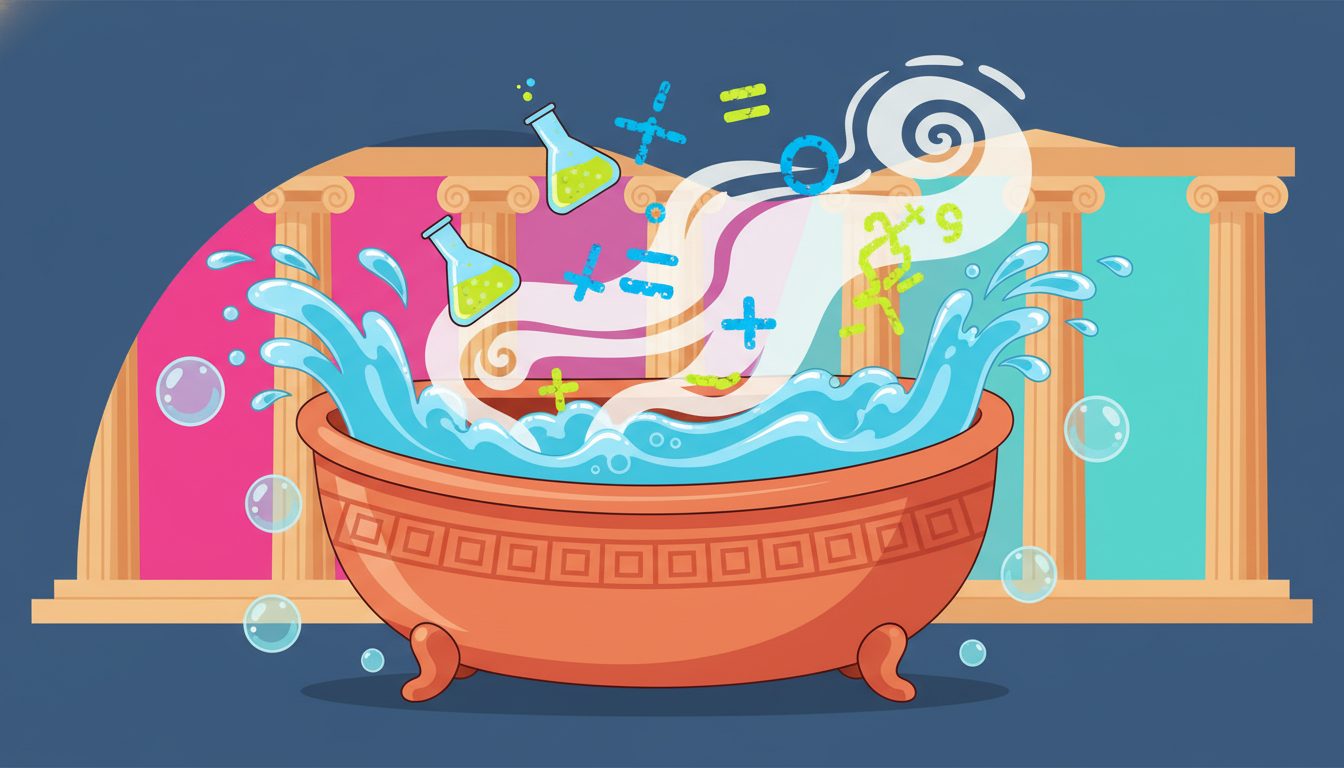
International Bath Day: Where Science Meets Self-Care
June 14th celebrates the moment a Greek mathematician stepped into a tub and changed physics forever. International Bath Day honors Archimedes’ famous discovery of water displacement - and gives everyone a perfectly good reason to draw a hot bath on a random Wednesday.
The Eureka Moment That Started It All
Around 250 BCE, King Hiero II of Syracuse suspected his goldsmith had cheated him - mixing silver into a crown that should have been pure gold. He asked Archimedes to figure it out without damaging the crown. The problem seemed impossible until Archimedes lowered himself into a full bath and noticed the water level rise.
He realized that the volume of water displaced equaled the volume of his submerged body. A gold crown and a silver crown of the same weight would displace different amounts of water because gold is denser. He reportedly ran through the streets naked shouting “Eureka!” - Greek for “I have found it!”
That bath-time observation became the foundation of fluid mechanics, a branch of physics that engineers still use today to design ships, submarines, and hydraulic systems. Not bad for a soak.
Bath Culture Around the World
Bathing has meant different things across cultures and centuries. Roman thermae were social clubs where deals were struck and gossip exchanged. Japanese onsen culture treats hot springs as meditative rituals with strict etiquette. Turkish hammams combine steam, massage, and community in a tradition spanning 600 years.
The modern bath industry has grown into a multi-billion dollar market. Bath bombs, essential oils, waterproof book holders, and chromotherapy tub lights have turned a basic hygiene task into an experience people photograph and share online. The #BathTime hashtag alone has hundreds of millions of views across platforms.
Health research backs up what bath enthusiasts already know: hot baths lower cortisol, improve sleep quality, and can burn roughly 140 calories per hour through passive heating. Regular bathers report lower stress and better cardiovascular markers than shower-only participants in multiple studies.